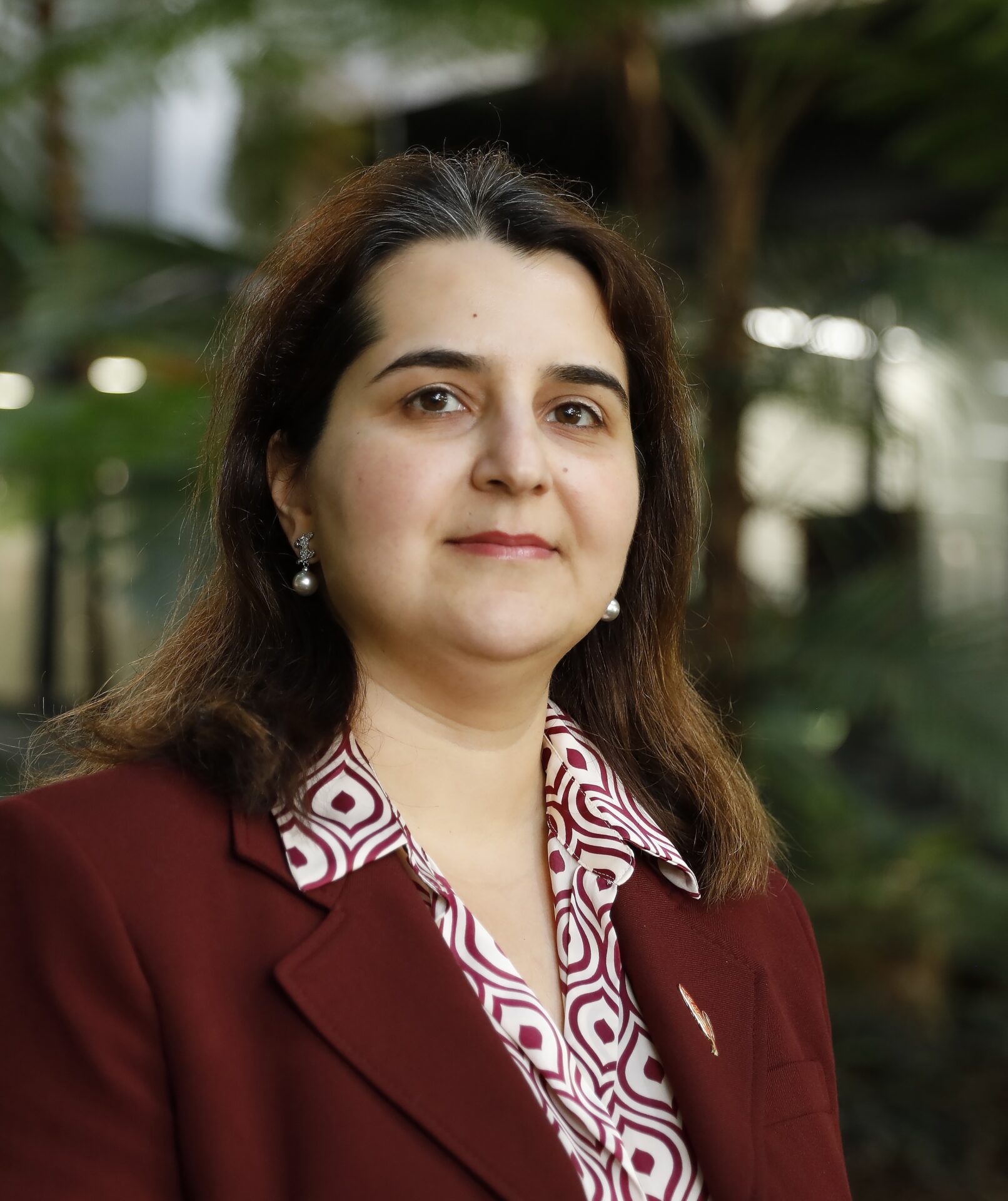
STEM Profile: Negin Fouladi Moghaddam

Negin Fouladi Moghaddam

Remote sensing scientist specialising in satellite Earth observation, SAR and InSAR.
Negin Moghaddam is a remote sensing scientist who turns satellite Earth observation into insight, using geospatial and AI techniques to monitor environmental change and surface deformation and support science, sustainable land management and informed decision-making.
City/town: Brisbane
State: QLD
STEMM sectors: Data/AI, Engineering, Research, Science, Technology
Open to being contacted about the following volunteer roles: Board positions, Mentoring others, New job opportunities, Speaking at professional events/panels, Speaking at schools
Guiding principle: Guided by curiosity, integrity and purpose, I turn science and technology into real outcomes for people, communities and the planet.
Areas of expertise: Satellite Earth Observation, Remote Sensing, Synthetic Aperture Radar (SAR), Deep learning

Q&A

Who is a woman in a STEMM field that you admire, or who has influenced your work?

Dr Fang Yuan inspires me through her leadership in Earth observation, combining scientific expertise, innovation and a commitment to building capability. Her work demonstrates how women in STEMM can drive technological progress while creating opportunities and inspiring the next generation.

What’s a problem in your field that keeps you up at night, and why does it matter to you personally?

What keeps me up at night is the growing gap between how fast our environment is changing and how well we can actually monitor it. I believe we need to turn Earth observation and AI into trusted, timely evidence- evidence that protects our landscapes and supports better decisions for generations to

Can you describe a moment in your work that completely changed how you think about your discipline?

The moment that changed everything was realising that satellite imagery is only a means to an end, its value lies in what we understand and act on because of it. It reframed my approach: from chasing better algorithms to building trusted, practical evidence that makes a real difference.

What’s something about your field that most people misunderstand or overlook?

People often see satellite imagery as simply pictures from space. What’s overlooked is the science behind turning those observations into reliable evidence- revealing changes across our landscapes that would be impossible to monitor consistently from the ground.

When have you taken a risk in your career, and what did you learn from it (regardless of the outcome)?

I took the risk of moving beyond established remote-sensing workflows into emerging SAR and InSAR technologies. Not every experiment worked, but I learned that innovation requires embracing uncertainty, testing ideas quickly, and treating setbacks as lessons that improve the next decision.

What’s a small, everyday habit or mindset that has made a big difference in how you approach your work?

I’ve made a habit of asking, “What decision will this evidence enable?” before diving deeper into a problem. It keeps me focused on purpose rather than complexity, helps me communicate technical work clearly, and reminds me that the best analysis is the one that leads to a useful outcome.

If you could collaborate with anyone (past or present, in or outside STEMM), who would it be and what would you want to explore together?

I’d collaborate with Dr. Bertrand Le Saux at ESA to explore how deep learning can make SAR and Earth observation more powerful for environmental monitoring. I’d be interested in developing scalable, generalisable models that turn complex satellite data into actionable evidence.

What role does creativity play in your work, and how do you nurture it?

Creativity helps me see beyond the obvious solution whether designing a new way to analyse EO data or connecting ideas across disciplines. I nurture it by staying curious, questioning assumptions, exploring unfamiliar approaches, and giving myself space to experiment before deciding what works.

How do you navigate moments of doubt or failure in high-stakes or highly technical environments?

I treat doubt and failure as information, not a verdict. I step back, question my assumptions, identify what I can control, and test the problem from another angle. In technical work, I’ve learned that setbacks often reveal the uncertainty that matters most and where the next breakthrough may lie.
What change, big or small, would you most like to see in the culture of STEMM fields over the next decade?

I’d like to see STEMM become more collaborative, open and comfortable with uncertainty. We need to value curiosity, interdisciplinary thinking and learning from failure not just polished results. The biggest breakthroughs often happen when people feel safe to question assumptions and share ideas.

What is the thing you enjoy most about your role?

What I enjoy most is turning complex Earth observation data into evidence that can support real decisions. I love the challenge of connecting science, technology and practical outcomes especially when a new EO approach moves from an interesting idea to something that can genuinely improve

What drew you to your field in the first place?

I was drawn to remote sensing because it reveals changes across landscapes, we cannot easily access. I became fascinated by how this data can support mineral exploration, monitor ground disturbance and environmental change, turning satellite observations into evidence for real-world decisions.