STEM Profile: Ruwangi Fernando

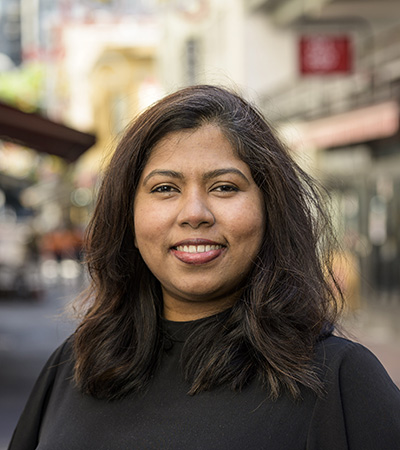
Ruwangi Fernando

Responsible AI researcher and technologist specialising in artificial intelligence, digital innovation, and inclusive technology, with experience across academia, industry and government.
Dr Ruwangi Fernando is an award-winning Responsible AI researcher, technologist and STEM entrepreneur. Founder of STEM Sisters, she champions equity in STEM and responsible technology, creating opportunities for underrepresented women and girls while contributing to research, policy and industry.
City/town: Melbourne
State: VIC
STEMM sectors: Data/AI, Education, Research, Technology
Open to being contacted about the following volunteer roles: Board positions, New job opportunities, Speaking at professional events/panels, Speaking at schools
Guiding principle: “Be the change you want to see, create opportunities, open doors for others, and use your knowledge and influence to leave the world more inclusive than you found it.”
Areas of expertise: Responsible AI, Artificial Intelligence & Machine Learning, STEM Equity & Inclusion, Technology Innovation & Entrepreneurship, Diversity and inclusion in STEM, Equity in STEM..

Q&A

What’s a problem in your field that keeps you up at night, and why does it matter to you personally?

What keeps me up at night is who gets left behind as AI rapidly reshapes our world. Technology can amplify existing inequities if diverse voices are absent. I care deeply because I believe innovation should expand opportunity not reinforce barriers.

Can you describe a moment in your work that completely changed how you think about your discipline?

During my PhD, I realised that building powerful AI was only part of the challenge, who designs it, whose experiences shape it, and who benefits matter just as much. It changed my focus from simply advancing technology to ensuring innovation is responsible, inclusive and human-centred.
What’s something about your field that most people misunderstand or overlook?

People often think responsible AI is mainly about fixing algorithms. What gets overlooked is the human ecosystem around them who builds AI, whose data and experiences are represented, who makes decisions, and who bears the consequences. Responsible AI starts with people, not technology.

When have you taken a risk in your career, and what did you learn from it (regardless of the outcome)?

Founding STEM Sisters was a leap into the unknown. I chose to build something I wished had existed when I needed it. It taught me that meaningful change rarely begins with certainty it begins with courage, listening, and the willingness to act before you have all the answers.

What’s a small, everyday habit or mindset that has made a big difference in how you approach your work?

I make a habit of listening before trying to solve. Whether I’m working with technology, research or people, asking “What am I missing?” has changed how I work. It keeps me curious, challenges my assumptions, and reminds me that the best solutions are rarely created alone.

What role does creativity play in your work, and how do you nurture it?

Creativity is how I connect ideas that don’t usually sit together AI, equity, education and community. I nurture it by staying curious, talking with people outside my field, and giving myself permission to ask, “What if we did this completely differently?”

How do you navigate moments of doubt or failure in high-stakes or highly technical environments?

In moments of doubt, I return to evidence, ask questions and seek perspectives beyond my own. I’ve learned that saying “I don’t know yet” is a strength, not a weakness. Failure becomes useful when I treat it as data something to learn from, adapt to and move forward.

What change, big or small, would you most like to see in the culture of STEMM fields over the next decade?

I want STEMM to move from simply inviting diverse people into the room to creating cultures where they genuinely belong, are heard and can lead. Over the next decade, inclusion should become part of how we define excellence in STEMM, not an initiative sitting alongside it.

What is the thing you enjoy most about your role?

What I enjoy most is seeing an idea become something that genuinely changes someone’s possibilities whether through technology, research, mentoring or creating opportunities. The most rewarding moments are when someone says, “I can see a place for myself here now.”

What drew you to your field in the first place?

I was drawn to technology by curiosity the idea that you could take a complex problem and create something that makes life better. Over time, that curiosity became a deeper purpose: not just asking what technology can do, but how we can use it to create meaningful and equitable change.